A customer sends their third comment on a P2 ticket. The tone shifts from professional to curt. The SLA is 40% consumed. Six hours later, an agent finally reads the message. By then, the customer has already called their account manager and asked to review the contract.
Every service desk has this story. Most don't know how many times it happens per month, because by the time someone notices the frustration, the customer is already gone.
This article presents the data on proactive versus reactive support, and why real-time sentiment detection delivers the highest return on investment of any ITSM capability today.
The Detection Gap
In a traditional service desk, frustration detection is manual and reactive. An agent reads a comment, recognizes the tone, and decides whether to escalate. This process has three fundamental problems:
1. Delay. The average time between a customer comment and agent review ranges from 30 minutes to several hours, depending on queue volume. During that window, the customer's frustration compounds with every minute of silence.
2. Inconsistency. One agent might flag a comment as frustrated. Another might read the same text and see a routine follow-up. Sentiment interpretation varies wildly between individuals, shifts, and stress levels.
3. Scale. A service desk handling 2,000 tickets per month generates 6,000 to 10,000 customer comments. No human team can analyze every comment for emotional trajectory in real-time.
The result: most escalations are detected after the customer explicitly demands escalation. At that point, the relationship damage has already occurred.
What Proactive Detection Looks Like
Proactive escalation prevention works by analyzing every customer comment the moment it arrives. The analysis goes far beyond keyword matching. Modern AI models evaluate:
- -Emotional tone: Is the customer frustrated, anxious, angry, or resigned?
- -Trajectory: Has the tone degraded across comments? A customer who went from polite to curt to hostile is on a clear escalation path
- -Urgency indicators: References to deadlines, business impact, or management involvement signal imminent escalation
- -Politeness degradation: When formal language disappears and blunt demands appear, the customer has mentally crossed a threshold
- -SLA context: A negative comment on a ticket with 80% of SLA consumed is more critical than the same comment on a fresh ticket
- -Conversation history: Three follow-ups in two days signals a different level of urgency than a first response
The AI produces a structured assessment: sentiment level (positive, neutral, negative, critical), escalation risk score, key phrases that drove the analysis, and recommended actions.
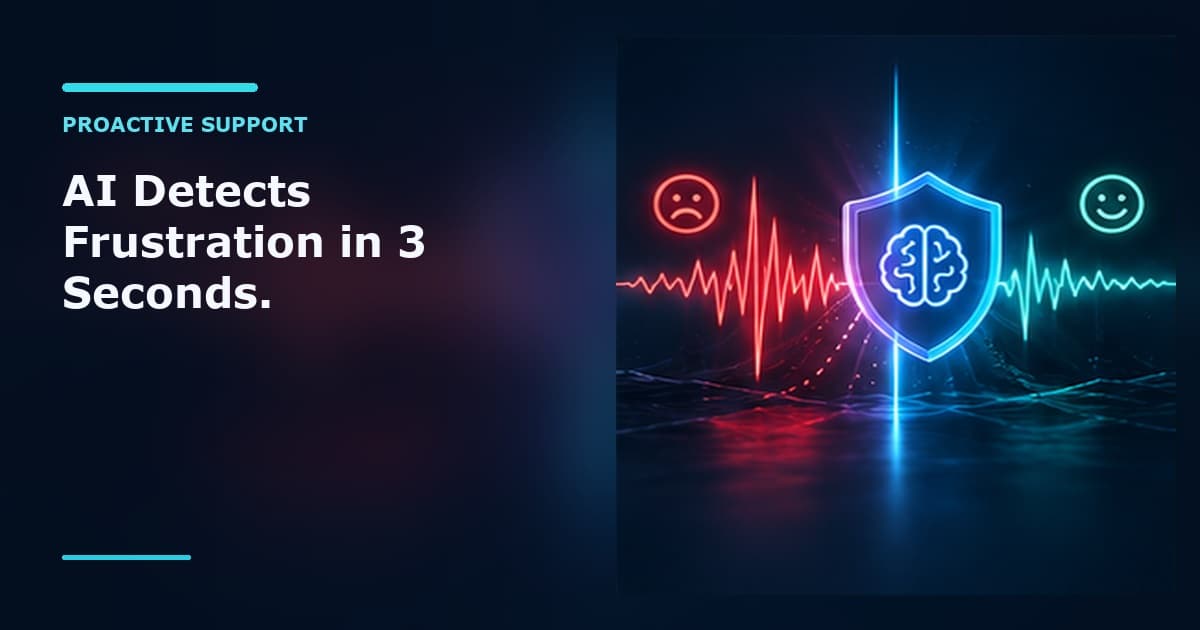
This entire analysis happens in under 3 seconds. No human triager required. No queue delay. Every single comment, analyzed before the next agent even opens their browser.
The Action Framework
Detection without action is just monitoring. Proactive escalation prevention pairs real-time analysis with automatic interventions:
| Action | What Happens | Why It Matters |
|---|---|---|
| Automatic Reassignment | Ticket is reassigned to a senior agent or escalation specialist | The customer gets someone with authority and experience before they have to ask |
| Watcher Notification | Team lead or account manager is added as a watcher | Leadership has visibility before the situation explodes |
| Internal Analysis Comment | AI posts a private comment with sentiment breakdown and key phrases | The next agent who opens the ticket has full emotional context, not just the technical details |
| Escalation Label | Ticket is flagged with a visible label (e.g., "escalation-risk") | Dashboards and filters can surface at-risk tickets without manual review |
These actions fire automatically based on configurable thresholds. A "negative" sentiment might trigger a watcher addition and internal comment. A "critical" sentiment might trigger full reassignment plus all other actions.
The key insight: every action happens before the customer sends their next message. The customer experience shifts from "nobody cares" to "someone noticed and acted."
The ROI Data
The financial case for proactive support is supported by consistent research across multiple sources.
Cost Reduction
- -Organizations using proactive monitoring experience an 83% reduction in critical system failures compared to reactive approaches
- -Proactive approaches save up to 30% in total support costs versus reactive break-fix models
- -Emergency and reactive repairs cost 2 to 3 times more than proactive service rates
- -Companies implementing AI-powered deflection report cost reductions of 30 to 55%
Source: SafeBox Tech: ROI of Proactive Monitoring
Source: CardinalTek: Hidden ROI of Proactive IT Support
AI Automation Results (2024-2025)
- -B2B SaaS companies using AI-first support see 60% higher ticket deflection and 40% faster response times (Gartner 2024)
- -AI automation can reduce support volume by 20 to 60%
- -Advanced AI implementations can resolve up to 80% of support tickets without human intervention
- -First response time improvements documented from 15 minutes to 23 seconds, a 97% reduction in documented case studies
- -Best-in-class AI implementations deflect up to 85% of routine questions
Source: Pylon: AI Ticket Deflection 2025
Source: EasyVista: AI in ITSM
Workforce Impact
Gartner predicts that by 2025, 80% of customer support organizations will apply some form of generative AI to improve productivity and customer experience. By 2029, agentic AI will autonomously resolve 80% of common customer service issues without human intervention.
The organizations deploying proactive AI today will have a 3-year head start in data quality, process maturity, and competitive advantage.
The First Contact Resolution Connection
Every conversation about support costs eventually leads to First Contact Resolution (FCR). The industry benchmarks are well-established:
- -Industry average FCR: 70% (SQM Group 2025)
- -Best-in-class FCR: 80%+
- -Escalation rate best practice: below 10%
The financial leverage of FCR is significant:
- -Every 1% improvement in FCR saves approximately $286,000 annually for a typical midsize support center
- -Every 1% FCR improvement correlates with a 1% improvement in customer satisfaction
- -Every 1% FCR improvement produces a 1% reduction in operating costs
Source: SQM Group: FCR Benchmark 2024
Source: MetricNet: First Contact Resolution Rate
Proactive sentiment detection improves FCR in two ways:
- -Prevention: By catching frustration early, the original agent can course-correct before the situation requires escalation
- -Smart reassignment: When escalation is necessary, routing to the right senior agent on the first reassignment prevents the multi-bounce escalation chain that destroys both FCR and customer trust
Side-by-Side: Reactive vs. Proactive Escalation Handling
The difference between reactive and proactive escalation management plays out in real time. Here's what the same scenario looks like under each approach:
The Scenario
A customer on a P2 ticket (VPN connectivity issue) sends three comments over 48 hours. Tone progressively deteriorates. SLA is 70% consumed.
Reactive Approach (No Sentiment Detection)
| Time | What Happens |
|---|---|
| T+0h | Customer sends third comment (frustrated tone) |
| T+4h | Agent reads the comment, doesn't flag it |
| T+8h | Customer sends fourth comment (angry, demands manager) |
| T+9h | Agent escalates to Tier 2 |
| T+12h | Tier 2 agent reads the full history, starts investigation |
| T+16h | SLA breached. Customer calls account manager |
| T+24h | Issue resolved by Tier 2 after involving Tier 3 |
| Result | SLA breach. Customer satisfaction: 1/5. Account review requested. |
Proactive Approach (AI Sentiment Detection)
| Time | What Happens |
|---|---|
| T+0h | Customer sends third comment (frustrated tone) |
| T+3s | AI detects NEGATIVE sentiment (0.25 score). Key phrases: "third time", "no response" |
| T+5s | Auto-actions: ticket reassigned to senior agent, team lead added as watcher, internal comment with analysis |
| T+20min | Senior agent reads ticket with full emotional context, prioritizes response |
| T+45min | Customer receives substantive response from someone with authority |
| T+3h | Issue resolved within SLA |
| Result | SLA met. Customer satisfaction: 4/5. No escalation request. |
The difference: 3 seconds of AI analysis versus 9 hours of human detection delay. Same ticket. Same customer. Completely different outcome.
The Annual Math: Prevention vs. Cost
For a mid-size organization processing 2,000 tickets per month:
| Metric | Without Prevention | With Prevention (estimated) |
|---|---|---|
| Monthly escalations | 200 (10%) | 60 (3%) |
| Escalation cost per ticket | $92 avg | $92 avg |
| Monthly escalation cost | $18,400 | $5,520 |
| Annual escalation cost | $220,800 | $66,240 |
| Annual savings | $154,560 | |
| Customer churn (annual) | 204 customers | 61 customers |
| Revenue protected (at $2,400 CLV) | $343,200 | |
| Agent turnover reduction | 15-25% fewer departures |
Conservative estimates suggest a 70% reduction in escalation rate when proactive detection is deployed effectively. The ROI calculation becomes straightforward: if your escalation prevention system costs less than $50,000 per year and saves $150,000+ in direct costs alone (before counting churn prevention and agent retention), the payback period is measured in weeks, not months.
What This Means for Your Service Desk Today
The technology gap between reactive and proactive support is closing fast. Organizations that deploy AI-powered sentiment detection now gain three advantages:
- -Immediate cost reduction from fewer escalations reaching Tier 2 and Tier 3
- -Customer retention from catching frustration before it becomes a switching decision
- -Agent retention from reducing exposure to hostile customer interactions
Forrester's data shows CX quality declining for the third consecutive year. The organizations investing in proactive customer intelligence are the ones pulling ahead. The rest are paying the escalation tax, quarter after quarter, without measuring it.
The question isn't whether proactive sentiment detection works. The data is clear on that. The question is how many more escalations you'll absorb before deploying it.
References
| Source | Data Point | Link |
|---|---|---|
| SafeBox Tech | 83% reduction in critical failures with proactive monitoring | ROI of Proactive Monitoring |
| CardinalTek | 30% cost savings, 2-3x reactive cost premium | Hidden ROI of Proactive IT |
| Pylon | 60% higher deflection, 40% faster response (AI-first) | AI Ticket Deflection 2025 |
| EasyVista | AI resolves up to 80% without human intervention | AI in ITSM |
| SQM Group (2025) | 70% FCR average, $286K per 1% improvement | FCR Benchmark 2024 |
| MetricNet | 1% FCR = 1% CSAT = 1% cost reduction | First Contact Resolution |
| Gartner (2025) | 80% autonomous resolution by 2029 | Agentic AI Prediction |
| Forrester (2025) | CX quality at all-time low, declining 3 years | Global CX Index |