Your IT service desk handles thousands of tickets per month. Your agents are trained, your SLAs are defined, your dashboards are green. Everything looks fine.
But behind those dashboards, one in five tickets is taking a detour.
Industry benchmarks consistently show that 15–25% of service desk tickets are initially assigned to the wrong team. Each misrouted ticket triggers a cascade of rework, reassignment, and wasted time that never shows up in a single metric, but compounds into six-figure losses annually.
This article breaks down the real cost of ticket misrouting, backed by published research from MetricNet, HappySignals, BMC, and Gartner.
The Data: How Often Tickets Get Misrouted
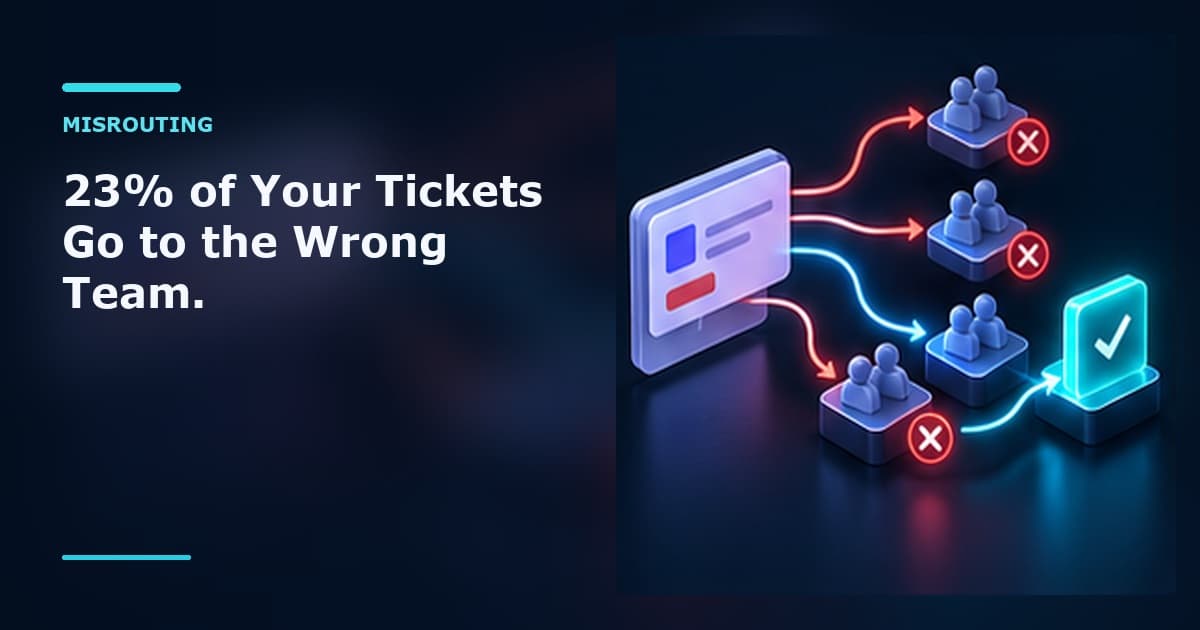
According to BMC's analysis of service desk operations, 23% of tickets get assigned to the wrong team initially, requiring an average of 2.3 transfers before reaching the correct resolver group.
Manual dispatch systems (where a human reads the ticket and decides where it goes) consistently produce 15–25% misrouting rates. The reason is straightforward: manual categorization requires perfect knowledge of every queue, every team, and every request type. No human dispatcher maintains that level of precision across thousands of tickets.
Source: BMC: Cost Per Ticket, The Ultimate Service Desk Metric
Source: Mizo Tech: Why Ticket Misrouting Is Killing Your SLA Compliance
What Happens After a Ticket Lands in the Wrong Queue
A misrouted ticket doesn't just sit there. It activates a chain of labor:
| Step | Who pays | Time cost |
|---|---|---|
| Agent reads the ticket, realizes it doesn't belong to their team | L1 Agent | 3–5 minutes |
| Agent reassigns or contacts the user for clarification | L1 Agent + User | 5–10 minutes |
| Ticket waits in the new queue (SLA clock already running) | SLA compliance | 15–60 minutes |
| User re-explains the problem to the new team | User + L2 Agent | 10–15 minutes |
| Resolution starts, now with context gaps from the transfers | Resolver | Variable |
The total impact? HappySignals' global IT experience data reveals that employees lose an average of 109 minutes of productivity per ticket reassignment. That's nearly two hours of lost work, per bounce.
And it compounds. A ticket that bounces four times consumes 8–9 hours of total lost time across agents and end users.
Source: HappySignals: The Real Cost of Reassigning IT Service Desk Tickets
The Financial Impact
MetricNet's 2024 benchmarking data establishes the baseline:
- -Average cost of a Tier 1 ticket: $22
- -Average cost of a Tier 3 escalation: $104+
A cleanly routed ticket costs $22. A misrouted ticket that bounces twice, involves rework, and escalates can cost $100–$130 or more, a 373% increase over a properly handled ticket.
Source: MetricNet: Service Desk Cost Per Ticket
Source: NetFor: Strategic Business Value of IT Help Desk Support
The Annual Math
For a mid-size organization processing 1,000 tickets per month:
| Parameter | Value |
|---|---|
| Monthly tickets | 1,000 |
| Misrouted at 23% | 230 tickets |
| Time wasted per transfer (45 min avg) | 172 hours/month |
| Agent fully-loaded cost | $45/hour |
| Monthly cost of misrouting | $7,762 |
| Annual cost of misrouting | $93,150 |
For organizations handling 5,000+ tickets per month, the annual misrouting cost exceeds $465,000.
These numbers reflect agent-side costs only. They do not include end-user productivity losses, SLA breach penalties, or the downstream effects of delayed resolution on business operations.
The SLA Impact Nobody Discusses
Misrouting doesn't just waste money. It compresses the time available for actual resolution.
- -For a 4-hour SLA, a single misrouting event consumes 25% of the available resolution window before the right team even sees the ticket.
- -For a 2-hour SLA, misrouting consumes 50% of the window.
When SLA breaches spike, the response is typically to hire more agents or expand coverage hours. But the root cause often isn't staffing. It's routing accuracy. You're paying for more people to handle tickets that shouldn't have reached them in the first place.
Source: Mizo Tech: Why Ticket Misrouting Is Killing Your SLA Compliance
The User Experience Cost
Beyond dollars and SLA metrics, misrouting erodes trust.
HappySignals data shows that employee happiness drops by 7+ points with each ticket reassignment. Users who experience multiple bounces develop learned helplessness. They stop using the portal entirely and resort to phone calls, emails, or shadow IT.
Phone support costs 3–5x more than portal-based self-service. Every user you push away from the portal is a user you'll serve at a higher cost through a less efficient channel.
Source: HappySignals: Ticket Bouncing and Frustrated End-Users
Why Traditional Approaches Don't Solve This
Most organizations address misrouting with one of three approaches:
1. Better training for dispatchers. Helps temporarily, but accuracy degrades as staff turns over and the service catalog evolves. With dozens of service desks and hundreds of request types, no human maintains perfect routing knowledge.
2. More granular categorization forms. This shifts the burden to the user, who now faces a wall of dropdowns and fields they don't understand. The result: users guess, categorize incorrectly, or abandon the form entirely.
3. Rule-based automation. Works for simple, keyword-based routing. Fails for nuanced requests where the correct destination depends on context, not just keywords.
What the Research Says About AI-Powered Routing
The data on AI-assisted ticket routing is compelling:
- -40–50% of tickets can be automated through AI routing and classification
- -Deloitte documented a case where ticket routing was streamlined from 30 minutes average to 6 minutes maximum, an 80% improvement
- -Organizations deploying AI-first support see $3.50 return for every $1 invested in the first year
- -Real implementations have achieved $1M+ in annual savings from routing improvements alone
Source: Deloitte: The Ticket to Maximized Uptime
Source: Freshworks: How AI Is Unlocking ROI in Customer Service
Gartner predicts that by 2029, agentic AI will autonomously resolve 80% of common customer service issues without human intervention. The organizations that start now will have a three-year head start on routing accuracy, data quality, and operational efficiency.
Source: Gartner: Agentic AI Prediction 2025
The Question for Your Next Quarterly Review
Pull your ticket transfer data from the last 90 days. Count the reassignments. Multiply by 109 minutes.
That's the number your dashboard isn't showing you.
For most organizations, the annual cost of misrouting alone justifies investing in intelligent routing. The technology exists today. The data supports it. The only question is whether you'll measure the problem before or after you solve it.
References
| Source | Data Point | Link |
|---|---|---|
| BMC | 23% misrouting rate, 2.3 transfers average | Cost Per Ticket |
| MetricNet | $22 avg Tier 1 cost, $104+ Tier 3 cost | Service Desk Cost Per Ticket |
| HappySignals | 109 min productivity loss per reassignment | Cost of Reassigning Tickets |
| HappySignals | 7-point happiness drop per reassignment | Ticket Bouncing |
| Mizo Tech | 15–25% misrouting rate benchmark | SLA Compliance Impact |
| NetFor / MetricNet | 373% cost increase on escalation | IT Help Desk Value |
| Deloitte | 80% routing speed improvement | Maximized Uptime Case Study |
| Freshworks | $3.50 return per $1 invested | AI ROI |
| Gartner (2025) | 80% autonomous resolution by 2029 | Agentic AI Prediction |